Reranker
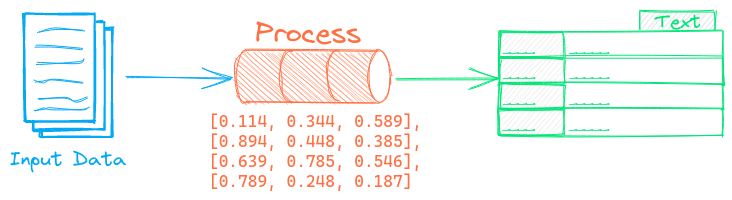
The Reranker pipeline runs embeddings queries and re-ranks them using a similarity pipeline.
Example
The following shows a simple example using this pipeline.
from txtai import Embeddings
from txtai.pipeline import Reranker, Similarity

# Embeddings instance
embeddings = Embeddings()
embeddings.load(provider="huggingface-hub", container="neuml/txtai-wikipedia")

# Similarity instance
similarity = Similarity(path="colbert-ir/colbertv2.0", lateencode=True)

# Reranking pipeline
reranker = Reranker(embeddings, similarity)
reranker("Tell me about AI")
Note: Content must be enabled with the embeddings instance for this to work properly.
See the link below for a more detailed example.
| Notebook | Description | |
|---|---|---|
| What's new in txtai 9.0 | Learned sparse vectors, late interaction models and rerankers |  |
Configuration-driven example
Pipelines are run with Python or configuration. Pipelines can be instantiated in configuration using the lower case name of the pipeline. Configuration-driven pipelines are run with workflows or the API.
config.yml
embeddings:

similarity:

# Create pipeline using lower case class name
reranker:

# Run pipeline with workflow
workflow:
  translate:
    tasks:
      - reranker
Run with Workflows
from txtai import Application

# Create and run pipeline with workflow
app = Application("config.yml")
list(app.workflow("reranker", ["Tell me about AI"]))
Run with API
CONFIG=config.yml uvicorn "txtai.api:app" &

curl \
  -X POST "http://localhost:8000/workflow" \
  -H "Content-Type: application/json" \
  -d '{"name":"rerank", "elements":["Tell me about AI"]}'
Methods
Python documentation for the pipeline.
__init__(embeddings, similarity, cache=None)
Creates a Reranker pipeline.
Parameters:
| Name | Type | Description | Default |
|---|---|---|---|
embeddings
|
embeddings instance (content must be enabled) |
required | |
similarity
|
similarity instance |
required | |
cache
|
optional document token cache; True bounds at 1000, False/None disable; other values use int(cache), non-positive disables |
None
|
Source code in txtai/pipeline/text/reranker.py
28 29 30 31 32 33 34 35 36 37 38 39 40 41 | |
__call__(query, limit=3, factor=10, **kwargs)
Runs an embeddings search and re-ranks the results using a Similarity pipeline.
Parameters:
| Name | Type | Description | Default |
|---|---|---|---|
query
|
query text|list |
required | |
limit
|
maximum results |
3
|
|
factor
|
factor to multiply limit by for the initial embeddings search |
10
|
|
kwargs
|
additional arguments to pass to embeddings search |
{}
|
Returns:
| Type | Description |
|---|---|
|
list of query results rescored using a Similarity pipeline |
Source code in txtai/pipeline/text/reranker.py
44 45 46 47 48 49 50 51 52 53 54 55 56 57 58 59 60 61 62 63 64 65 66 67 68 69 70 71 72 73 74 75 76 77 78 79 80 81 82 83 | |