LemurTrainer
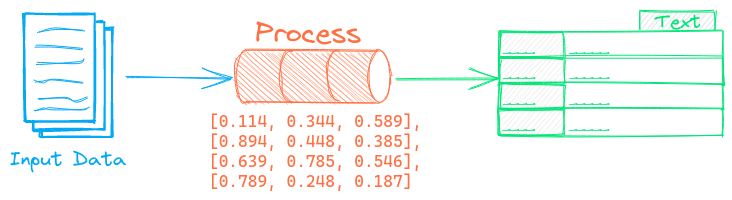
Trains a LEMUR fixed dimensional encoder for a late interaction model and corpus. Training is a separate pipeline step; the saved
artifact is then loaded through the embeddings vectors.lemur configuration.
LemurTrainer owns training-data construction, feature-model setup, epoch training and validation-based selection. The loaded LEMUR
pooler remains responsible for query-feature and document-weight encoding.
Example
from txtai.pipeline import LemurTrainer

corpus = [
    "First document",
    "Second document",
    "Third document",
]

trainer = LemurTrainer()
trainer(
    "colbert-ir/colbertv2.0",
    corpus,
    "lemur-model",
    epochs=100,
    validationsplit=0.1,
)
epochs is required so the training mode is explicit. Use epochs=100 for the quality-oriented MLP setting. This can take hours on
a CPU. Use epochs=0 to select deterministic random ELM features as a lower-cost fallback.
The learn distribution defaults to learncategory="query". Target documents are always encoded with the data encoder, so the
default encodes selected corpus texts once as data and once as queries. Set learncategory="data" to reuse the data encodings, or
pass a separate iterable of texts with learn.
When vectors.center is omitted, the trainer encodes the corpus without centering, computes one mean over all corpus token rows and
uses that mean to center both data and learn vectors before fitting. The collection mean is stored in the LEMUR artifact. An explicit
vectors.center setting keeps its configured behavior and does not store an automatic collection mean.
Set corpussubsetsize to a positive integer to sample that many raw corpus texts under seed before either encoding pass. The
default is None, which uses every corpus text. trainsubsetsize and learnsubsetsize apply later, after token vectors have already
been created. corpussubsetsize applies to data; a separate learn iterable remains caller-sized.
For trained MLP features, set validationsplit to a fraction greater than zero and less than one to retain the epoch with the lowest
held-out loss. The default is 0.0, which preserves training-loss selection. The selected one-based epoch, loss and metric are
available as selectedepoch, selectedloss and selectionmetric on the fitted or reloaded encoder.
MLP training displays a tqdm progress bar on an interactive terminal, including percent complete and the current validation loss
when validationsplit is enabled (or training loss otherwise). Progress output is disabled for non-interactive runs.
The artifact contains config.json and model.safetensors. It stores the inference feature model, output-normalization statistics,
token sample needed to encode documents added after training and, by default, the collection token mean. The training-only output
readout is not saved.
Load the artifact in an embeddings configuration.
embeddings:
    path: colbert-ir/colbertv2.0
    vectors:
        lemur:
            path: lemur-model
Search behavior
Loading a LEMUR artifact with a stored collection mean automatically centers both query and document token vectors with that mean.
This keeps training and search on the same representation and makes fixed vectors independent of indexing or query batch size. An
explicit vectors.center setting takes precedence. Older artifacts without a stored mean use the standard late-pooling fallback:
batch centering for models with multiple linear layers and no centering for models with zero or one linear layer.
LEMUR approximates standardized MaxSim targets, so useful ranking scores can be negative. txtai's dense vector path L2-normalizes the fixed vectors and removes results with scores less than or equal to zero. This can change ordering and return fewer than the requested number of candidates compared with raw maximum inner-product search.
The Faiss backend uses exact IDMap,Flat search through 5,000 rows and switches to an IVF index above that threshold. In the measured
scifact run, default IVF reduced LEMUR NDCG@10 by 43% relative to exact search, compared with 25% for MUVERA. For LEMUR corpora above
5,000 rows, either pin faiss.components to an exact index or tune the IVF settings for the corpus. The exact configuration is:
embeddings:
    path: colbert-ir/colbertv2.0
    vectors:
        lemur:
            path: lemur-model
    faiss:
        components: IDMap,Flat
Methods
Python documentation for the pipeline.
__call__(path, data, output, gpu=True, method=None, tokenizer=None, maxlength=None, vectors=None, learn=None, learncategory='query', corpussubsetsize=None, validationsplit=0.0, **kwargs)
Trains a LEMUR feature encoder.
Parameters:
| Name | Type | Description | Default |
|---|---|---|---|
path
|
late interaction model path |
required | |
data
|
iterable of corpus texts |
required | |
output
|
artifact output directory |
required | |
gpu
|
tensor accelerator setting |
True
|
|
method
|
optional pooling method |
None
|
|
tokenizer
|
optional tokenizer path |
None
|
|
maxlength
|
maximum token length |
None
|
|
vectors
|
additional model arguments |
None
|
|
learn
|
optional iterable of texts used to learn features, defaults to data |
None
|
|
learncategory
|
encoder category for learn texts (data or query) |
'query'
|
|
corpussubsetsize
|
optional maximum number of corpus texts selected before encoding |
None
|
|
validationsplit
|
fraction of sampled learn tokens held out for validation |
0.0
|
|
kwargs
|
LEMUR fit arguments |
{}
|
Returns:
| Type | Description |
|---|---|
|
fitted LEMUR encoder |
Source code in txtai/pipeline/train/lemur.py
26 27 28 29 30 31 32 33 34 35 36 37 38 39 40 41 42 43 44 45 46 47 48 49 50 51 52 53 54 55 56 57 58 59 60 61 62 63 64 65 66 67 68 69 70 71 72 73 74 75 76 77 78 79 80 81 82 83 84 85 86 87 88 89 90 91 92 93 94 95 96 97 98 99 100 101 102 103 104 105 106 107 108 109 110 111 112 113 114 115 116 117 118 119 120 121 122 | |